
State and Investor Variations in Closing Docs: Why Lenders Can’t Afford to DIY
Blog_ State & Investor Variations - insert image 

Every closing package starts with the same federal foundation. TRID, RESPA, TILA—these federal requirements are fixed across the board, and most lenders have them well in hand. But the federal layer is only the foundation. What comes next is where things get complicated and where lenders who are managing growth without a structured approach to document generation start adding risk they may not even be aware of. 

The variation introduced by state law and investor requirements isn't a niche problem. It's a structural one, and the patchwork processes most lenders use to manage it tend to hold right up until they don't. 

A closing package that is complete and compliant in one state can be materially deficient in another. That's not a hypothetical: it's the daily operational reality for any lender originating across multiple jurisdictions. 

Not All Closing Packages Are Created Equal 

Most lenders set out to build consistent, scalable closing processes. But as origination volume grows and loan types multiply, gaps accumulate, and state law is where the first layer of real complexity enters the picture. 

Attorney states require that a licensed attorney prepare or review closing documents, and in some cases be physically present at the table during signing/loan closing. Non-attorney states follow different rules. Eligibility for remote online notarization (RON) varies by jurisdiction. Transfer tax disclosures, rescission rights, and state-specific forms all differ (sometimes substantially) from one state to the next. 

Edge Cases Get Expensive 

Broad state-to-state differences are generally understood and, with the right infrastructure, manageable. The more dangerous territory is the edge case: the requirement that falls outside routine workflows and prompts your team to improvise rather than solve systematically. These are the situations where tribal knowledge substitutes for process, and where exposure quietly builds. 

A few examples illustrate just how specific—and how consequential—these requirements can be: 

  • Texas Section 50(a)(6). Missing or incorrect constitutional disclosures on home equity loans give the borrower the right to demand that the lender forfeit all principal and interest collected if the defect is not cured within 60 days. This isn't a fine or a slap on the wrist—it's a potential forfeiture of the entire loan's economics. 
  • Florida documentary stamp tax. Florida requires a documentary stamp tax on the note in addition to the deed, and that requirement must be reflected specifically in the closing disclosure. Miss it, and you're looking at a disclosure defect on a closed loan. 
  • Washington Consumer Loan Act disclosure. Certain loan types in Washington require a specific disclosure under the Consumer Loan Act. The form is Washington-only and has no analog in other states, which means it's precisely the kind of requirement that gets overlooked when your team is working from memory. 

These aren't obscure technicalities. They're real requirements with real consequences, and they represent only a fraction of the state-level variation your document process has to account for at scale. 

Investor Requirements Are an Entirely Separate Layer 

Once you've accounted for state law, you're not done. Investor requirements introduce a second, independent layer of complexity that sits on top of everything else. 

GSEs maintain their own uniform security instruments by state. These instruments are not identical across states, and they change regularly, sometimes without much advance notice. Correspondent investors layer on further with their own closing instructions, required language, and delivery standards. If you're managing multiple correspondent relationships, you're effectively managing multiple document standards simultaneously, each with its own update cadence. 

Acquisitions compound this. When you absorb a new team, you inherit investor relationships that may not map cleanly onto your existing workflows or document systems. Reconciling those inherited relationships falls to compliance staff who are already stretched thin. 

And when investor guidelines change, the update rarely comes with lead time. Your team either catches it proactively or discovers the gap after the fact, usually in the form of a post-purchase finding. 

When Patches Become the Process 

The typical response to this kind of complexity is incremental: append a form, add a note to a spreadsheet, rely on the one person who handled that loan type before. These manual patches address immediate problems. They are not durable solutions. 

What makes this dynamic insidious is that it compounds across both layers—state and investor—simultaneously. A patch that addresses a state disclosure requirement doesn't help you when a correspondent investor updates its closing instructions. And vice versa. The patchwork grows in parallel with your business, and the gaps within it multiply. 

The patch holds until origination volume increases, a requirement changes, or the person who knew the workaround leaves. When it fails, it tends to fail at the worst possible moment: a closing, an audit, a post-purchase review. 

The Stakes of Getting It Wrong 

Document errors in correspondent lending can trigger a repurchase demand or an indemnification obligation. Errors may also require having the borrower return and re-sign documents. An outdated state disclosure creates audit exposure. The wrong investor-specific/investor-required document surfaces as a post-purchase finding. None of these outcomes is cheap, and none is easily reversed after the fact. 

Beyond the direct costs, there's the operational drag of staff time spent manually chasing state-specific requirements or reconciling investor instructions. And the reputational cost of recurring compliance failures with correspondent partners is real, even when it's hard to put a number on it. 

The downstream cost of a document error almost always exceeds what it would have cost to get it right at the outset. That's the fundamental economics of getting document generation right. 

A Better Approach to Document Complexity 

If your team is carrying this compliance burden manually, it's not because you made bad decisions. It's because your business grew faster than your processes—a gap that widens gradually and feels manageable until it isn't. 

DocMagic's document generation engine is built around the reality that state requirements and investor guidelines are not static. Our rules-based system absorbs all transactional data to dynamically produce a compliant document package while evaluating critical transaction information at every phase of the mortgage lifecycle, from initial disclosures through closing. State-specific forms, investor-specific/investor-required documents, correspondent closing instructions: all of it is tracked and applied automatically, so you're not depending on manual patches or institutional memory to stay current. 

The result is a document process that scales with your business instead of fracturing under it. If you're ready to move beyond the patchwork, we'd love to show you how it works. 

Title Alias (URL Slug)
state-and-investor-variations-in-closing-docs-why-lenders-cant-afford-to-diy

DocMagic introduces critical ADA-compliant loan documents

DocMagic, Inc., the premier provider of fully-compliant loan document generation, regulatory compliance, and comprehensive eMortgage services, announced the addition of ADA-compliant mortgage loan documents to its extensive document library. The new digital documents are accessible to visually impaired users and others with disabilities, unlocking opportunities for these consumers into the broader mortgage market.

Designed For Accessibility

“Much of modern lending technology is designed to give consumers the convenience to access loan documents in the ways that work best for them,” said Dominic Iannitti, president and CEO of DocMagic. “It is imperative that our industry remain inclusive of all borrowers, and that we design solutions that are accessible to all. By creating ADA-compliant documents, we can continue to ensure that more borrowers are able to easily access, and participate in, the loan process.”

DocMagic’s ADA-compliant loan documents are dynamic, data-driven and designed to automatically identify and index critical document components during the document generation process. ADA metadata tags are applied to each of these components within the documents. These metadata tags function like HTML code, logically displaying a document’s organizational structure and content hierarchy. The metadata tags include content-level details as well as descriptive text for images, logos, etc. along with specific semantic instructions designed to make all text understandable via an advanced Text-To-Speech (TTS) engine that accurately translates on-screen information into clear speech through earphones or speakers.

Implementation For ADA-Compliant Digital Mortgages

The new ADA-compliant documents have been implemented at scale by some of the nation’s largest financial institutions, enabling them to serve more clients and lead the way in providing a heightened level of customer support and an exceptional user experience. Lending entities of all types and sizes trust DocMagic's document generation and eMortgage services to streamline the mortgage lending process, resulting in significant business benefits and a measurable ROI.

To comply with the Americans with Disabilities Act (ADA), digital content must be free of barriers that may prevent those with disabilities from accessing information. Mortgage lenders that implement ADA-compliant documents promote equality and accessibility for disabled borrowers nationwide. Additionally, they help lenders mitigate legal complaints and resulting fines based on ADA standards. Ultimately, DocMagic’s ADA compliance project is a crucial step in the mortgage industry that creates a more inclusive and accessible world for those living with disabilities.

For more information about the new ADA-compliant document library, contact DocMagic’s digital mortgage experts.

Related Content:

Categories
Title Alias (URL Slug)
docmagic-introduces-critical-ada-compliant-loan-documents

FormAnalyzer 2.0 puts Form Management under your control!

FormAnalyzer™ by DocMagic allows users to view, manage, customize and configure their electronic forms from within a powerful, self-service web application. Powerful search capabilities enable review and analysis of the data elements and sophisticated programming we employ to render your documents. This dynamic tool lets users peruse document configuration settings, regulatory information and more — putting enhanced and advanced form management under user control.

FormAnalyzer™ provides access to DocMagic’s extensive forms library that includes 250,000+ documents. Some of the features include comprehensive search capabilities based on regulatory relevancy, keywords, programming strings, MISMO X-paths and more. The Preview feature has options for viewing documents with or without sample data, eliminating surprises and providing the opportunity to see a document exactly as the borrower would see it. With customizable configuration settings users can view high-level document metadata, including historical tracking and regulatory revisions.

FormAnalyzer™ provides users with next-generation tools to better manage documents and ultimately improve the borrower experience. 

Related Content:


Categories
Title Alias (URL Slug)
formanalyzer-2.0-puts-form-management-under-your-control

Did You Know: You can cut out the middleman and draw your own docs?

Some lenders pay an intermediary, such as a law firm, processing center or fulfillment company, to generate their mortgage documents and conduct print fulfillment services.

Did You Know iconHowever, lenders can cut out the middleman and draw their own docs — at the exact same quality and at a fraction of the price — by using DocMagic’s document generation solution for initial disclosures and closing documents.
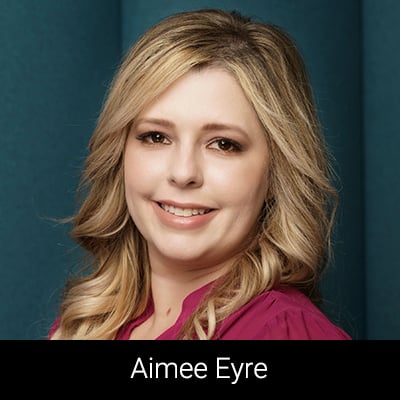


“I think some lenders are hesitant to take on that doc gen burden,” said Aimee Eyre, a sales executive at DocMagic. “But drawing their own docs is easier than they think, and it would save them a lot of money.”

Another reason that lenders use a fulfillment company is because many lack an in-house compliance expert and the intermediary companies offer compliance checks as part of their service — but so does DocMagic’s doc gen solution, which includes an automated compliance system designed to catch any errors and issues before documents are processed. Aimee Eyre-name

In fact, “a lot of fulfillment companies that use DocMagic advertise that they’ll handle the compliance piece for the lender, but they’re actually using DocMagic’s compliance system,” said account executive Shandi Smith.

Smith and Eyre often get calls from lenders who realize their fulfillment company is using DocMagic for document generation.

“They say, ‘I saw your logo in the bottom corner of the box and wanted to talk to you directly,’” Eyre said. 

To reiterate, there are a host of advantages for lenders who draw their own docs, including:Shandi Smith-name

  • Money: What DocMagic’s document generation clients pay to draw a doc gen set is a fraction of what they have to pay to the intermediary companies to do it for them.
  • Time: When lenders use DocMagic, it takes less than 10 seconds to generate a doc set. When lenders go through an intermediary, the process is out of their hands; they have to get in line and are at the mercy of whatever time frame the fulfillment company sets, which could be as much as two to three days. By using DocMagic’s document generation solution, lenders have the power to pull documents on their schedule, putting them firmly in control.
  • Compliance: DocMagic’s document generation solution comes with built-in compliance checks, supplied by an expert team that’s constantly monitoring the regulatory landscape to ensure the document library is evergreen. As Smith noted, in many cases, lenders are already getting DocMagic’s compliance service if their fulfillment company is also using DocMagic.
  • Ease: Some lenders worry that generating their own documents is a complicated process. That couldn’t be further from the truth. “As soon as you show lenders a demo, they realize that it’s not as hard as they thought it would be,” Eyre said. Smith added that after lenders are trained, they become extremely proficient at pulling their own docs.

DocMagic’s Sales Team can be reached at sales@docmagic.com.

Related Content:

Categories
Title Alias (URL Slug)
did-you-know-cut-out-the-middleman-draw-your-own-docs

AmeriSave leverages DocMagic’s Total eClose, doc gen solutions to maximize productivity

AmeriSave, one of the country’s largest mortgage lenders — best known for pioneering the first truly digital mortgage experience for borrowers — has been utilizing DocMagic’s Total eClose and document generation solutions to drive digital mortgage efficiency.

"DocMagic has been a wonderful partner to work with throughout the pandemic and refi boom, proving to be a key technology partner that has helped rapidly scale AmeriSave," said Magesh Sarma, AmeriSave’s CIO. "We look forward to continuing our partnership with DocMagic to establish even more efficiencies for our customers and internal teams."

AmeriSave, which offers simple self-service options so that borrowers can directly engage in the loan process, has grown exponentially over the past several years, in part by leveraging DocMagic’s technology to establish system-wide interoperability, newfound business process efficiencies, compliance adherence, and more. DocMagic’s document preparation solution, eSigning and eClosing technology, which integrate tightly with AmeriSave’s proprietary loan origination system (LOS), has helped AmeriSave operate smoothly throughout a volume-intensive environment.

Many of DocMagic’s functions automatically occur at the appropriate time within the workflow of AmeriSave’s LOS — without any human intervention whatsoever. This maximizes employee productivity throughout the lending process, including with many of AmeriSave’s vendor partners.

“AmeriSave understands the importance of always ensuring that borrowers have as many options and tools as possible available at their fingertips to walk away with a good experience that ultimately creates repeat business,” said Dominic Iannitti, DocMagic’s president and CEO. “Everything we do at DocMagic places ease of use, simplification and elegant design as a top innovation priority, which is reflected by AmeriSave’s ongoing achievements. We are elated that AmeriSave is having such immense success with our technology.”

Moving forward, AmeriSave plans to implement DocMagic’s remote online notarization (RON) capability, eNotes and eVault technology to establish further lending efficiencies.

Related Content:

Title Alias (URL Slug)
amerisave-leverages-total-eclose-doc-gen-solutions

Did You Know: You can get all your eClosing needs met by one vendor?

Some lenders think the only path to an eClosing is by employing a wide variety of vendors; for example, one vendor for document generation, another for compliance, another for electronic signatures, and so on.

Did You Know iconBut that’s a misconception. Not only is it possible to have a single-source vendor for all eClosing needs — it’s optimal.

“The lenders I speak to are really interested in using a doc provider that's foundational, that can provide everything,” said Darlyn Buthsombat, an account executive at DocMagic. “They want to use a doc provider that can also do eSign, that can also run all of the necessary compliance checks and have everything that’s needed for an eClose solution.”

An end-to-end technology vendor like DocMagic can provide what lenders need for every step of the eClosing process — something not even all DocMagic customers may realize. Lenders who are using DocMagic for document generation and eSignature are also in position to use the Total eClose platform to conduct any hybrid closing they want, or even a fully paperless eClosing, complete with eNotes, eVault and eNotarization options. 

Darlyn Buthsombat-mug with name“Sometimes I will run into a customer that was using another e-signature vendor because they didn’t know that we have eSign available for the disclosures,” Buthsombat said. “And then once they see our solution, they switch because it just makes more sense.”
Lenders who use multiple vendors can run into a variety of issues, including:

  • Inefficiencies and errors: Having multiple vendors adds more steps to the process, which also becomes noticeably slower as every step requires a wait for each disparate system to complete its job. Additionally, if a problem should crop up, it may take longer to resolve because of the uncertainty over which vendor may have caused it, forcing lenders to deal with multiple customer service teams. While DocMagic has an open application programming interface (API) to easily integrate with alternate technology solutions, other tech vendors may not have an open API, potentially disrupting the process flow between multiple vendors and resulting in duplicated efforts for the lender. By using a single vendor, lenders get a seamless experience, with the entire doc gen or eClosing process taking place in one environment.
  • Compliance: While most vendors run their own compliance, it might only apply to their specific specialty, which could complicate the process. “When the system is using different vendors and they run compliance, it doesn’t know which interpretation to believe,” Buthsombat said. “For example, one vendor may run the compliance audit but not the high-cost test, so that vendor might have a question on their audits or different information relating to the high-cost test. It can create some inconsistency there.”
  • Vendor management: It is simply more of a hassle managing multiple vendors versus having one. Multiple vendors lead to multiple logins and passwords, multiple accounts and billing cycles to manage, and multiple onboarding processes and training sessions. There’s also continued education and communication for updates, which can seem repetitive when received from several different providers. Lenders also have to do their due diligence and ensure that every individual vendor is adhering to all compliance and security standards.

Lenders could avoid all these issues by using an effective single-source provider with years of experience and a record of success.

A few weeks ago, DocMagic signed a new client who had been using five separate vendors: one each for document generation, compliance, eNotarization, eVault and ad hoc signing.

However, the client will now get all those services provided by DocMagic.

“They switched to DocMagic because they were looking for a single-source provider,” Buthsombat said. “They wanted to eliminate the additional steps and inefficiency caused by using multiple vendors. Now their eClosing process is more seamless and efficient.”

DocMagic’s Sales Team can be reached at sales@docmagic.com.

Related Content:

Title Alias (URL Slug)
did-you-know-you-can-get-all-your-eclosing-needs-met-from-one-vendor

What is data validation and why is it so important?

The first step of a closing is for a massive amount of information — about the borrower, the property and the type of loan — to be entered into the lender’s loan origination system (LOS). Data validation is the process by which that information is audited and verified.

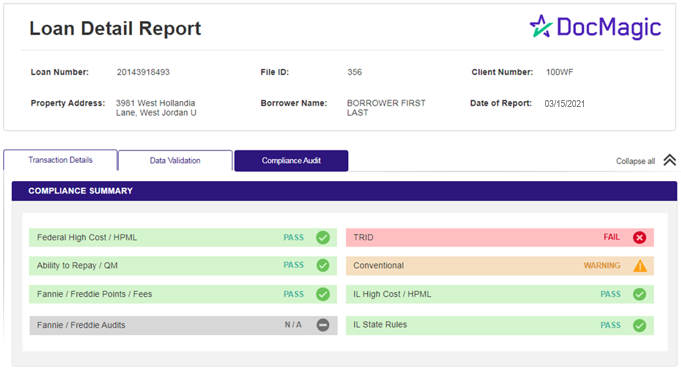
DocMagic's Loan Detail ReportGood data validation is crucial. For a variety of reasons (such as how the data is received, the size of the required data set and the complexity of the information), information may be incomplete, incorrect or improperly formatted — potentially causing major disruptions for lenders later on in the process. Lenders need a data validation system that confirms the loan data they’re collecting is complete, accurate and compliant at the state, federal and investor level.

“It’s a health integrity check of all of the loan’s data, to ensure that you have a complete and accurate data set prior to a document generation event,” said Chris Lewis, DocMagic’s Director of Enterprise Solutions.

What makes for a strong data validation system?

An effective data validation system should be able to analyze this data as it’s being submitted in order to catch errors and inconsistencies, such as if the zip code doesn’t match the state or if information such as the interest rate is missing, to name a few.

The best data validation systems should have a multilayered error-detection program, such as an audit engine that’s constantly analyzing the loan data. In addition to that, the system should generate a loan report that highlights any inaccurate, missing or questionable information. At the touch of a button, lenders should be able to pull up a laundry list of any issues that need to be addressed.

Of course, even if they lack an audit engine or loan report, lenders could still start plugging data into their LOS and generate a document package — but it's much more likely this would result in errors they won’t spot until much later.

“Maybe it’ll have an unpopulated field or generate documents in a non-compliant way,” Lewis said. “The old way is where lenders would generate documents and then look at them and realize, ‘I still need to add this or that,’ instead of being able to ensure everything is correct beforehand. Lenders could generate documents that way, but it would take a lot longer and be a lot more error prone.”

As part of data validation for both its document generation and 100% paperless Total eClose solutions, DocMagic offers an audit engine and Loan Detail Report that guarantees lenders can generate compliant document packages. The Loan Detail Report can be provided in both XML and browser-ready HTML formats.

On top of that, DocMagic also offers lenders the ability to configure custom audits according to their needs (for example, to flag things such as if a property in a specific zip code is over a certain price threshold). Additionally, after over 30+ years of operation and millions of closings, DocMagic has developed thousands of prebuilt audits that instantly spot potentially questionable data.

“Lenders are doing all the legwork to do their best to get complete and accurate data into the documents they generate, but using an automated data audit and validation engine can greatly reduce errors and double as a quick way to know what data you have left to collect,” Lewis said. “DocMagic’s platform gives lenders the benefit of all these other loans that have been closed in a compliant way on our platform, and of us providing rulesets that ensure they’re collecting quality data. That’s the endgame: quality data that’s complete.”

Related Content:

Title Alias (URL Slug)
what-is-data-validation-why-is-it-important

Case study: Amid pandemic, new lender flourishes in remote environment

At the start of the pandemic, companies across America were abruptly forced to send their employees home and quickly scramble to adjust to remote work. But even though new lender MortgageCountry had just begun operations, its president, Ira Brownstein, wasn’t worried.

After all, MortgageCountry’s employees were already working remotely—because that’s how Brownstein structured the company. MortgageCountry’s unique, 100% virtual business model is just one reason why the company has not only survived but is thriving during one of the most challenging economic times in modern history.

Download the MortgageCountry case study

“You can be much more connected on a virtual basis and be much more productive, and we’re living proof—not by force, but by foresight,” Brownstein said.

The new company began accepting loan applications as most of the country was shutting down. And yet, with the help of DocMagic’s Total eClose and dynamic document generation solutions, MortgageCountry was able to implement an electronic workflow from start to finish in less than 30 days. 

MortgageCountry’s success has only continued since then:

  • In its first month of accepting applications, it closed loans in an average of 13 days.
  • It has partnered with the four largest financial institutions in the mortgage space—even though these institutions rarely partner with startups.
  • It secured $35 million of mortgage credit facilities during an economic calamity, providing a runway to originate more than $700 million in annual mortgage originations.

How did MortgageCountry do it? In addition to their business model, they chose the right technology partners: DocMagic for document generation and eClosing, and LendingQB for its loan origination system (LOS) and point-of-sale system (POS).

This was key because MortgageCountry set up ambitious goals for onboarding and digital closings. A week before launch, they requested that all documents be digitally enabled and wanted their first closings to be hybrid and to close on a digital platform. DocMagic made it happen.

In retrospect, Brownstein admits he was taking a risk with such ambitious goals. “It was all new. I didn't come from an environment where we were closing loans digitally. We were closing loans the way most lenders close, with outdated wet signatures,” he said. “But I'm a big believer that you make a decision, do your due diligence, test your decision, and ensure that you mitigate risk, and we did that.”

To learn more about how MortgageCountry found success amid challenging economic conditions, download the free case study.

Related Content:

Title Alias (URL Slug)
case-study-mortgagecountry-lender-remote-environment

DocMagic, VirPack integrate platforms

DocMagic has integrated with VirPack to facilitate the seamless exchange of loan files and docs for compliant eSigning through DocMagic’s eSign platform.

Using VirPack’s API, electronically signed documents can automatically be accessed and retrieved from DocMagic’s eSign platform and delivered to the appropriate party, establishing a secure and seamless exchange of sensitive borrower information and documents. Customers will be alerted to all DocMagic eSign platform events via user notifications.

RON: The last mile in the eClosing marathon

The integration centralizes a paperless environment to maximize operational efficiency, eliminate errors, and reduce costs. Furthermore, the seamless connectivity speeds up funding and quickly delivers loan files to investors, GSEs, the FHA, servicers, QC firms, MI firms, and other relevant parties.

“This integration helps our mutual clients to efficiently automate document workflows and consolidate the retrieval and packaging of documents according to their specific preferences,” said Steve Ribultan, director of business development at DocMagic. “Ultimately, we’re bringing a greater level of organization and centralization to bundling executed documents for borrowers, lenders, and investors.”

VirPack simplifies virtual document management for the lending industry by providing user-centric solutions for loan file management, e-delivery, and file indexing with full text OCR to significantly increase productivity and modernize business operations.

“VirPack is pleased to strengthen our partnership with DocMagic,” said Wayland Pond, VirPack’s COO. “The integration results in more secure document exchange and alleviates manual processes by leveraging e-signature and e-closing technology. This partnership further underscores our commitment to modernizing mortgage lending workflows. Our technology focuses on improving operations by limiting manual intervention, reducing operational overhead and oversight, and increasing loan transparency.”

Related Content:

Title Alias (URL Slug)
docmagic-virpack-integrate-platforms

MortgageCountry closing loans in 13 days using DocMagic solutions

During its first two months of lending, MortgageCountry has been closing loans in an average of 13 calendar days—setting a new standard for speed.

The new mortgage banker accomplished this feat with the help of DocMagic’s 100% digital e-enabled documents and Total eClose™ platform.

How they did it: Download the MortgageCountry case study

“DocMagic completely exceeded our expectations, helping us make our origination and closing process next-level efficient and creating a second-to-none closing experience for our clients,” said Sheila Salvitti, MortgageCountry’s director of communications and social media. “After seeing the level of perfection achieved, we knew we chose the right technology partner to realize our belief that the sky is the limit.”

The feeling was mutual. “It was a pleasure collaborating with the tech-savvy, forward-thinking team at MortgageCountry in a combined effort to master the eClosing process before they ever funded a single loan,” said Dominic Iannitti, DocMagic’s president and CEO. “The unprecedented success we had with the solution configuration, troubleshooting, and implementation of the platform helped set up MortgageCountry to be one of the most efficient independent mortgage bankers in the country."

Working with with DocMagic’s eClosing team, CountryMortgage was able to automate its entire eClose workflow from start to finish in less than 30 days. Salvitti said DocMagic tailored Total eClose™ to CountryMortgage’s business needs, helping them be “flawless from the start.”

Founded in 2019, MortgageCountry entered the industry with a mission to cut the cost of a mortgage by using forward-thinking technology and a re-engineered mortgage process. The company's unique business model includes the fact that it's run virtually via a 100% browser-based technology.

MortgageCountry identified that the primary reason for rising costs is the industry’s reliance on a large outside sales infrastructure, absorption of mortgage brokers, and corporate expenses throughout the banking industry. It aims to reverse this trend by partnering with the best technology partners to provide an intuitive and simple platform that meets clients everywhere and anywhere.

“To be successful in today’s fast-moving, rapidly changing lending landscape, implementing the right technology is business-critical to disrupt an industry plagued with good ideas but poor execution,” Salvitti said. “MortgageCountry has successfully delivered on our promise to make the client experience as simple, quick and easy as possible.”

MortgageCountry reported that its clients valued the fact they were able to receive the complete closing documents well ahead of the closing and could sign on their own time without a rigid schedule. Clients said the process was more comfortable than prior experiences because they were able to review and sign the closing documents without the pressure of someone looking over their shoulder.

To learn more about how MortgageCountry found success amid challenging economic conditions, check out our updated blog post, where you can download the free case study.

Related Content:

Title Alias (URL Slug)
-mortgagecountry-docmagic-solutions
RSS Feed

One provider for all your mortgage technology.