Ginnie Mae, 3 FHLBanks start accepting eNotes

eNotes are having a moment. Last month, Ginnie Mae formally kicked off its Digital Collateral Program to begin the process of accepting electronic promissory notes—or eNotes—and other digital loan documents as collateral.

A few weeks before that, on July 1, the Federal Home Loan Bank of Des Moines became the first of the 11-member FHLB system to announce it would accept residential mortgage eNotes as collateral. By mid-July, FHLB Dallas followed suit, while FHLB Chicago just announced two days ago that it was also on board.

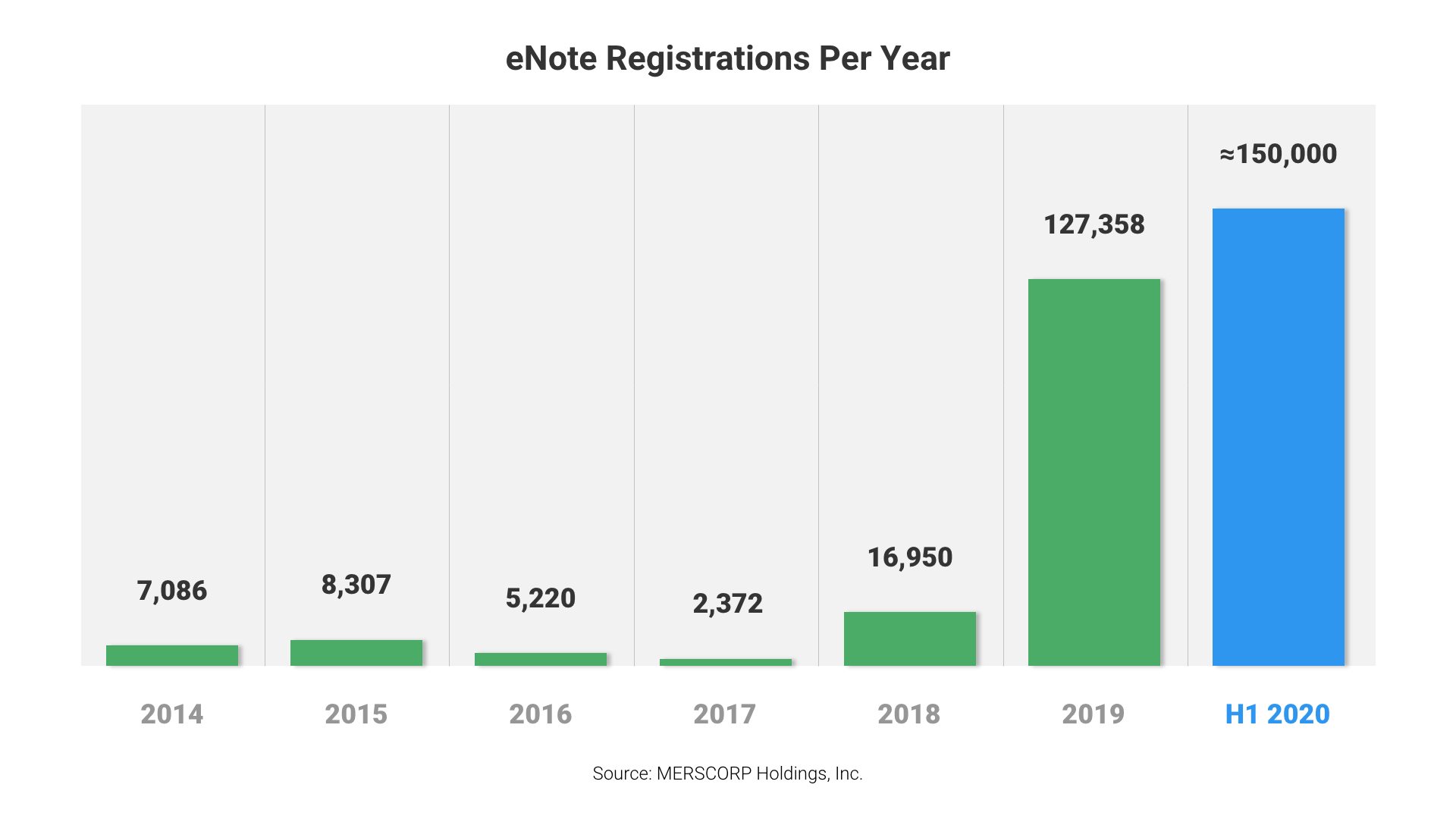
On top of that, MERSCORP registered an all-time monthly high of 40,170 eNotes in July, while the number of eNotes registered in the first half of 2020 alone (just under 150,000) already outpaces the total registered in all of last year (127,358). It's clear that eNotes are the wave of the mortgage industry's future.

Compliance Alert: What lenders should know about Ginnie Mae's new program

With this move Ginnie Mae, a federal agency that guarantees bonds issued against pools of FHA and VA mortgages, follows in the footsteps of GSEs Fannie Mae and Freddie Mac, which have been accepting eNotes for a few years now and are to date the largest buyers of eNotes.
Enote Reg Graph

eNotes have been on an upward trajectory since early 2018, but this year the pandemic—due to social distancing mandates and a growing preference for closing loans remotely—has accelerated its adoption. Since July, eNote registrations have set a new monthly record in 10 of the last 12 months, MERSCORP has seen a 1,300% increase in companies starting the process to integrate their operations to eNotes, and 18 warehouse lenders are currently funding eNotes—up from one in 2015.

"It’s fair to say that 2020 has been the year of the eNote," said Chris Lewis, DocMagic's Director of Enterprise Solutions. "In my opinion, by the end of the year, any investor that doesn’t accept eNotes will be in the minority and will lose business opportunities as a result."

Related Content:

Categories
Title Alias (URL Slug)
ginnie-mae-fhlbanks-begin-accepting-enotes

Webinar: How mortgage industry should adapt to COVID landscape

For the mortgage industry, a lot has changed in a short amount of time—especially when it comes to remote online notarization (RON), according to the speakers at DocMagic’s May 27 webinar, “Road-Tested eClosing Strategies for Today.”

“The RON landscape accelerated three years in three weeks, and that’s no joke,” said Mike Lyon, the executive vice president at Nexsys Technologies. “The industry went from ‘it’s a nice-to-have’ to ‘we have to have it.’ Nothing says social distancing like a remote online notarization.”

Click here to watch a free recording of the webinar.

Yet lenders shouldn’t just embark on a mad scramble to immediately implement RON, with its shifting landscape of changing legislation; instead, they should immediately begin doing hybrid closings, said Chris Lewis, DocMagic’s Senior Account Executive for Enterprise Solutions. Even if lenders can’t go 100% digital for awhile, they can still move in that direction by completely cutting paper out of the process except for the recordable documents: the note and deed of trust.

“This is easily scalable, it can be implemented in a very short period of time, and it puts you on the path to that fully digital transactional experience,” Lewis said.

The webinar’s other speakers included:

  • Jason Nadeau, the chief digital officer at Fidelity National Financial. He noted that one of the key challenges is that RON technology, while legal in many places, is still risky for underwriters and settlement agents. “We’re talking about all new laws, all new practices, all new procedures—so they’re all untested in court,” he said. “It’s not about what’s legal, it’s about the risk profile.”
  • Ben Sherman, president of Synrgo, who cited statistics and challenges for county recorders. “When it comes to the world of county recording there’s a lot of confusion and unknowns,” he said.
  • Brian D. Pannell, DocMagic’s Chief eServices Executive, who explained why lenders should begin offering eNotes. Their popularity had been increasing even before the coronavirus crisis, Pannell said, displaying a graph showing that the number of eNotes registered with MERS® jumped from over 100,000 in all of 2019 to over 250,000 in the first quarter of 2020 alone.

Click here to watch a recording of the webinar, including more in-depth background information, recommendations, and the Q&A session.

Related Content:

Title Alias (URL Slug)
mortgage-industry-adapt-to-covid-landscape

Pandemic leads to growing acceptance of eClosings: News source

The coronavirus pandemic has led to wide-ranging industry acceptance of eMortgages, eNotes, and digital closings, according to a recent article in National Mortgage News (subscription required).

Even before the pandemic, eMortgage transactions were on the rise. In April 2019, the MERS eRegistry saw 8,338 eNotes registered; by March 2020, that number had shot up to 24,519, an all-time high.

To learn road-tested eClosing strategies you can implement now, join our free webinar on May 27.

Since then the momentum has swung even more toward eClosings. Since March at least 20 states have taken emergency action to allow temporary remote online notarization (RON)—considered crucial in the age of social distancing—joining 23 states with permanent RON laws on the books. At the same time lenders are rushing to implement systems that utilize RON and electronic documents. 

DocMagic Chief eServices Executive Brian Pannell noted that DocMagic can have clients set up for hybrid eClosings (including eSign and ancillary documents) in as little as 24 to 48 hours.

“Key to implementing a smooth e-close process is ensuring the lender's workflow is well thought out ... which we hold our clients' hands in doing," he told National Mortgage News. "That includes ensuring all docs are e-enabled and leverages a single-source platform with both hybrid and RON capability. We can implement a completely digital and fully paperless total e-close in 17 days, and e-enabled dynamic docs is critical to that."

To learn more, read the article (subscription required).

Related Content:

Title Alias (URL Slug)
pandemic-growing-acceptance-of-eclosings

QRL Leverages DocMagic's eVault Technology to Purchase eNotes from Corresponding Clients

PR-banner

Gains competitive advantage, speeds funding process, results in fewer exceptions

Anaheim, Calif., Oct. 29, 2018—Annual CUNA Lending Council Conference - DocMagic, Inc., the premier provider of fully-compliant loan document preparation, regulatory compliance and comprehensive eMortgage services, announced that QRL Financial Services (QRL), a nationwide provider of residential mortgage lending services for community banks and credit unions, has leveraged its eVault technology to purchase eNotes. The announcement was made during the 24th Annual CUNA Lending Council Conference at the Disneyland Hotel in Anaheim, Calif.

Implementing an eVault means QRL can increase new business by extending its reach to lenders that are ready to implement eClosings and sell eNotes. In addition to providing improved service, they will competitively position themselves for the future. The deal will make QRL one of the first investors outside of the GSEs to begin purchasing eNotes.

“QRL is a farsighted organization, and by implementing eVault technology now, they stand to capitalize on marketplace opportunities as eNotes continue to gain adoption,” stated Dominic Iannitti, president and CEO of DocMagic. “We tend to partner with early adopters like QRL, who will reap the benefits of their industry insight. We look forward to the success they realize by utilizing our eVault and supporting technology.”

Because QRL is using DocMagic’s SmartDocs, all documents retain a tamper evident seal to ensure data and document integrity. Using static documents, that don’t include SmartDoc transactional (XML) metadata, means some organizations have the difficult, costly and time-consuming task of confirming that data and documents are in sync.

“Offering a truly paperless solution is the future. Consumers will expect and demand a closing experience that is more timely, convenient and informative," says Alex Rivera, managing director at QRL Financial Services. "QRL’s ability to purchase and service eNotes will allow the credit unions and community banks that we service to stay ahead of the technology curve as they compete with the larger institutions in the race to improve the mortgage experience.”

The solution will also create greater secondary market process efficiencies because of reduced cycle times. QRL will be able to fund faster with fewer post-closing document issues.

Contact Michael Chaney, michael@docmagic.com to schedule a meeting. 

Categories
Title Alias (URL Slug)
qrl-leverages-docmagics-evault-technology-to-purchase-enotes-from-corresponding-clients

Freddie Mac Expands eMortgage Solutions with DocMagic's eVault Technology to Store and Control eNotes

evault-blog

Technology to validate data, assure quality and compliance for all pre-funded home loans

TORRANCE, Calif., Sept. 18, 2018DocMagic, Inc., the premier provider of fully-compliant loan document preparation, regulatory compliance and comprehensive eMortgage services, announced today that Freddie Mac has implemented its SaaS-based eVault technology and SmartREGISTRY™ platform.

DocMagic’s eVault provides a secure electronic repository for storing documents and performing automated eNote certification to Freddie Mac eMortgage lenders via Loan Selling Advisor®. By automating the eNote certification process, Freddie Mac will speed the funding process, thereby improving liquidity in the mortgage markets and reducing lender’s warehouse line costs.

“Freddie Mac is committed to streamlining the mortgage process for lenders and borrowers, and has been a leader in purchasing eMortgages since 2006,” said Andy Higgenbotham, Freddie Mac’s Single Family Chief Operating Office. “We rolled out our automated certification process in 2015 to speed up the funding process, thereby improving liquidity in the mortgage markets and reducing lender’s warehouse line costs. We are now expanding this process to include the DocMagic platform.”

DocMagic’s eVault provides safe and secure storage for sensitive loan documents. It also automatically parses and validates data in a SmartDoc eNote against data in the user’s core system of record. Additionally, DocMagic’s SmartREGISTRY platform enables holders of eNotes to securely transfer these electronic documents to other eVault systems, such as those used by investors, conduit aggregators and servicers. Ultimately, it facilitates real-time access, delivery, storage and much needed control of electronic loan files.

“Freddie Mac has been a long-time visionary and champion of eMortgages over the years and has made great strides with their unwavering commitment to automation across the supply chain,” stated Dominic Iannitti, president and CEO at DocMagic. “Now, with the successful rollout of SmartDoc eNote data validation prior to funding, this demonstrates the advantages and a clear-cut ROI of going completely ‘e.’ We look forward to ongoing collaboration with Freddie Mac and to further adoption of the digital mortgage process.”

Notable is that that Freddie Mac encourages the use of ‘SMART’ (securable, manageable, archivable, retrievable, transferable) eNotes because static documents do not contain source data, and thus make it difficult, costly and time consuming to confirm the data on documents match.

DocMagic established a process that guides lenders on how to begin using SmartDoc eNotes. The company’s eVault technology is integrated with its Total eClose™ platform, which is a comprehensive eClosing solution that creates a 100 percent paperless digital mortgage process — from origination through eClosing, eWarehouse lending, investor eDelivery and eServicing.


About DocMagic: DocMagic, Inc. is the leading provider of fully-compliant loan document preparation, compliance, eSign and eDelivery solutions for the mortgage industry. Founded in 1988 and headquartered in Torrance, Calif., DocMagic, Inc. develops software, mobile apps, processes and web-based systems for the production and delivery of compliant loan document packages. The company’s compliance experts and in-house legal staff consistently monitor legal and regulatory changes at both the federal and state levels to ensure accuracy. For more information on DocMagic, visit www.docmagic.com.

Categories
Title Alias (URL Slug)
freddie-mac-expands-emortgage-solutions-with-docmagics-evault-technology-to-store-and-control-enotes

Join DocMagic at Digital Mortgage Conference 2018

dig-mortgage-conf-18

Heading to Las Vegas for the Digital Mortgage Conference?

Whatever your unique business model, we can help you prepare for your next generation of buyers! Our suite of technology solutions advances the mortgage process at every stage, improving the experience for lenders and settlement service providers with:

  • An extensive eDocument Library plus eSignature technology
  • MISMO category one compliant SMARTDoc® eNotes
  • eNotary Technology for all 50 states
  • Direct connectivity with MERS® eRegistry
  • An irrefutable Audit Trail for proof of compliance
  • A secure, certified eVault
  • An Investor eDelivery channel

We'll be at kiosk #318, ready to support your eMortgage process. Book some time directly to your calendar!

Book a Meeting!
 
Categories
Title Alias (URL Slug)
join-docmagic-at-digital-mortgage-conference-2018

LoanCare now subservicing eNotes with DocMagic’s eVault Technology

evault_blog.pngA leading national subservicer opens up market opportunities by servicing eNotes stored electronically via DocMagic's eVault Technology.

VIRGINIA BEACH, Va. – October 20, 2017 – LoanCare, a ServiceLink company, announced today that it has begun utilizing DocMagic, a provider of fully-compliant loan document preparation, regulatory compliance and comprehensive eMortgage services, in order to add eVaulting capabilities to its process. This allows LoanCare to begin servicing loans registered with MERS® as eNotes.

LoanCare is a subservicer operating in all 50 states, servicing more than 1 million loans. Clients of LoanCare can now begin servicing loans stored electronically as eNotes, using an eVault that is secure, compliant and scalable while providing process transparency.

“By utilizing DocMagic, we have established a competitive advantage and created the opportunity to store and subservice loans housed in an eVault, making us the premier subservicer for electronically closed loans,” said Gene Ross, executive vice president of strategy and business development at LoanCare. “After performing a careful evaluation of vault providers in the marketplace, it became clear that DocMagic was the software company that could enable us to broaden our services for our clients.”

DocMagic has an existing integration with the MERS® eRegistry system that registers originated or purchased loans as eNotes. After MERS® registration, the eNote is securely transferred to DocMagic’s eVault, and then can easily and efficiently be serviced by LoanCare. Loan details that are stored in DocMagic’s eVault can be referenced and reported on, so that in the event of an audit, LoanCare can provide proof of compliance for its clients such as TRID and other rules and regulations.

For all eNotes that LoanCare services, DocMagic retains a complete electronic audit trail, tracking every event and securely storing both data and documents for the life of the loan.

“As states continue to adopt more convenient notarization for consumers to enable digital signing of mortgage documents, we anticipate greater market acceptance that will drive the ease in which loans are originated,” said Dave Worrall, president of LoanCare. “One example was North Carolina’s recent achievement of its first ever eClosing – our servicing of that electronic mortgage loan utilized DocMagic’s technology. By providing eVault services to our clients and the marketplace, we plan to continue to be a leader of technology and process innovation.”

“With eClosings starting to gain adoption among lenders, LoanCare’s use of our eVault opens up a substantial opportunity for them to capture market share while operating efficiently, cost effectively and compliantly,” said Dominic Iannitti, president and CEO of DocMagic. “Our Total eClose™ single platform solution enables lenders to close loans without any paper involved whatsoever. The industry adoption of eClosings that we are seeing is significant. LoanCare is a visionary organization that has prepared itself to start servicing eNotes by harnessing the right technology ahead of the curve.”

DocMagic's eMortgage solutions have been thoroughly vetted and approved by Fannie Mae, Freddie Mac and MERS® to compliantly support all three eMortgage categories for eVault, eNote and eClosing. In addition to its SaaS-based eVault, DocMagic also offers an on-premise eVault solution that is available through eSignSystems, a DocMagic owned and operated company.

Title Alias (URL Slug)
loancare-now-subservicing-enotes-with-docmagic-evault-technology

Going "E" from End to End, Part 2

tim_a.pngBy Tim Anderson

The days of no pressure are over. Any lender that hasn’t already waded into the ePool had better be ready to jump. With immense regulatory pressure looming, the old method of just doing something is no longer sufficient. It's time for a new tack.

The recent news about the IRS decision is an ex- ample of this. With all the buzz around this news, we’re already hearing from lenders who are interested in a point solution that will allow them to take advantage of this decision for doing business with the IRS. This makes sense because this is front and center in the news, but since these lenders are not considering how this decision impacts the rest of their business, it’s short sighted.

The 4506-T is just one document and while it makes good sense to make the ordering, accepting, processing, filing and storing that document all electronic, what about all the other documents? The e-signature part of this solution can and should be applied elsewhere in the enterprise. When it is extended, it should be done the same way. If it’s good enough for the goose, it’s good for the gander as well.

Seeking a paperless map. Electronic signatures are more than a digital picture of a signature; they are a process, a ceremony. E-sign is a legal process that includes proof that the borrower actually viewed every document, whether there’s a signature or not. Auditors will demand to know if the borrower actually viewed every document. There are also requirements around whether the signature is embedded or an overlay. There are other requirements around how the lender provides the tamper- evident seal. Investors have a lot to say about what is actually involved.

Providing a common and consistent eSigning experience. These processes can vary by vendor, but using different types of e-sign technology across an enterprise can cause problems with investors, to say nothing of confusing borrowers and degrading the consumer’s experience. Remember, from the consumer’s perspective, there are many other documents they would like to sign electronically. If the lender hopes to get consumer adoption, the same tools should be used across the entire process and borrowers should not be asked to sign some documents electronically and others traditionally.

Lenders no longer have the luxury of gently moving into the paperless world. They need to get in soon and they need to take their entire lending process with them. That means that institutions will be seeking solutions that will get all of the paper out. Lacking that, they will seek out partial solutions that already carry within them the map for the future steps that will get them fully electronic.

The very best way to ensure that is to work with a vendor who can take you down that road as fast and as far as you want to go, but in no case slower than the government requires. Choosing a vendor that can only provide a point or piecemeal solution, without a plan for getting to the next step, will put the institution at risk.

An “e”nterprise solution, from application, to closing, to servicing. A good RFP will go a long way toward separating those players who cannot provide a complete solution from those that can. It will also reveal which vendors understand the nuances—from application all the way to closing and loss mitigation—that could impact the lender’s ability to comply with investor and regulatory guidelines. Moving into electronic lending is no longer a simple, cheap or fast implementation. Like everything else in this business, it requires careful consideration.


This is part one of a two-part article on the industry-wide transition out of paper-based processes to electronic, from application through to closing and servicing. Tim Anderson is the Director of eServices at DocMagic.

Posted with permission from The Mortgage Executive Magazine.

Title Alias (URL Slug)
going-e-from-end-to-end-part-2

Going "E" from End to End, Part 1

tim-new.jpgBy Tim Anderson

For years a core group of us has been telling the industry that it’s time to get the paper out of our systems. We’ve performed studies that show paper is more expensive, that it takes more time to process, is usually missing pages or signatures, or gets lost. It took the foreclosure crisis to really bring home to the industry the negative implications of lost or incomplete documents. After billions of dollars in settlements to federal regulators and attorneys, it looks like our industry is finally ready to say goodbye to paper forever, or at least a majority of it.

Anyone who has yet to be convinced will get all the persuasion they need when the Consumer Financial Protection Bureau implements the Three Business Day Rule for mortgage loan closings. When lenders and their closing agents are forced to deliver a correct settlement statement to the borrower three days before closing, they’ll learn just how difficult it will be to get everything right and on time in a paper world. Taking their businesses fully electronic will be the only way to ensure compliance.
The good news is that the vast majority of lenders are already moving in that direction. In January, the industry got a boost when the IRS announced that it would finally be accepting electronically signed documents for the ordering of 4506-T tax transcript orders. The FHA, one of the very few remaining federal government holdouts, is expected to follow suit later this year.

The worry now is how lenders will go about making that important transition. Pushing the point solution. For much of the past decade or so, electronic lending advocates like myself have been urging lenders to quit worrying about their entire enterprise and just pick a process and take it electronic. By taking out the paper in a piecemeal fashion, lenders would at least be moving in the right direction and selling themselves on the benefits of paperless lending in the process. This tactic worked for a number of reasons.

First, it was inexpensive. When it comes to technology systems, it always costs less, in the short run, to isolate your systems and concentrate on a single process. This kind of razor sharp focus lets technologists create workable solutions more quickly. But if we’ve learned anything from the foreclosure process, it’s that there are no truly unconnected systems in our business (or at least there shouldn’t be). Ultimately, the lower price tag enticed more lenders to dip their toes into the paperless world and this was good news.

Second, when the project is kept tight and focused, it doesn't take long to configure and test a solution. This meant technologists could finalize their work faster on isolated processes and deliver successful pilots to lenders more quickly. In the end, a successful test is the only way to convince an executive to move more deeply into a solution.

The biggest reason that partial solutions were beneficial in the early days is that by getting lenders to experience their business without paper, the benefits that researchers promised proved to be real. It became clear to the industry that it really did make sense to do everything electronically.

This prompted more lenders to take another step into the digital world, and another one after that. Because the industry was under no real pressure to make this shift work, many lenders made a gentle transition toward fully electronic systems and are enjoying the benefits today.


This is part one of a two-part article on the industry-wide transition out of paper-based processes to electronic, from application through to closing and servicing. Tim Anderson is the Director of eServices at DocMagic.

Posted with permission from The Mortgage Executive Magazine.

{{cta('92144eec-8ead-4b32-969f-8ddeea62763b')}}


Title Alias (URL Slug)
going-e-from-end-to-end-part-1

Corporate Settlement Solutions Implements DocMagic's Total eClose™ Solution

ipad-deal.pngPress Release:

Fully TRID-compliant solution delivers superior service and a competitive advantage

TORRANCE, Calif., Sept. 29, 2016—DocMagic, Inc., the premier provider of fully-compliant loan document preparation, compliance, eSign and eDelivery solutions, announced that Corporate Settlement Solutions (CSS), a title and settlement services company, has successfully implemented DocMagic’s Total eClose™ solution.As a result, CSS can offer a completely new customer experience, gain a competitive advantage, and remain 100 percent TRID compliant at all times.


“We recognized early on that in order to differentiate ourselves from a crowded marketplace, it was paramount to offer elevated service to our clients,” said Jerome Jelinek, CEO and general counsel at CSS. “With the addition of DocMagic’s Total eClose, we offer lenders the opportunity to transform their mortgage origination process through the elimination of paper, thereby significantly reducing costs and increasing efficiencies.”


CSS combined DocMagic’s functionality, services and integrations into a single offering to create an easy-to-use, out-of-the-box eClosing solution. DocMagic’s Total eClose functionality unites eNote, eSignature, eNotary, MERS eRegistration, eDelivery, and eVault services to provide a highly-efficient, paperless end-to-end eClosing. In addition, documents that need to be notarized can be conveniently eSigned and eNotarized without leaving the comfort of their home.


“We are excited that CSS is successfully leveraging our Total eClose solution to provide a completely electronic closing process for their customers,” said Dominic Iannitti, president and CEO of DocMagic. “As a settlement service provider, it is impressive that CSS has taken a leading role in promoting the benefits of eClosings and as an early adopter, they will enjoy a significant advantage over their competitors.”


After the introduction of TRID and its increased liability for lenders and their assignees, if you originate, sell, buy or service loans, you must be able to demonstrate TRID compliance years after a loan closes. DocMagic’s system provides electronic proof and evidence of compliant transactions for future audits with a date and time stamp audit trail of everyone who has touched the transaction at any level. From the original loan application and Loan Estimate (LE) to receipt of delivery of the final Closing Disclosure (CD), data, calcs and documents are stored in an eVault to provide the ability to replicate proof of compliance.


With TRID’s increased compliance requirements and soon the implementation of the new Uniform Closing Dataset (UCD) requirement, the future is in fully-electronic transactions that help lenders meet strict timing requirements and provide the ability to fully recreate all compliance checks at every point in the transaction. The CFPB and industry experts agree that it’s better to adopt and implement the technology and processes to make eClosings a reality now as opposed to later.

About DocMagic
DocMagic, Inc. is the leading provider of fully-compliant loan document preparation, compliance, eSign and eDelivery solutions for the mortgage industry. Founded in 1988 and headquartered in Torrance, Calif., DocMagic, Inc. develops software, mobile apps, processes and web-based systems for the production and delivery of compliant loan document packages. The company’s compliance experts and in-house legal staff consistently monitor legal and regulatory changes at both the federal and state levels to ensure accuracy. For more information on DocMagic, visit www.docmagic.com.

About CSS
Corporate Settlement Solutions (CSS) is a dynamic, forward-thinking group of real estate settlement service professionals with a focused passion for providing a superior customer experience. The company started as a local title agency in northwest Michigan in 1992. CSS’ growth fostered expansion into a regional vendor management company offering a full range of title, closing, valuation, flood, and recording products. The company offers powerful title software for accurate and efficient
title and settlement transactions as well as an and-to-end eClosing solution. For more information, go to www.visitcss.com.

Title Alias (URL Slug)
corporate-settlement-solutions-implements-docmagics-total-eclose-solution
RSS Feed

One provider for all your mortgage technology.